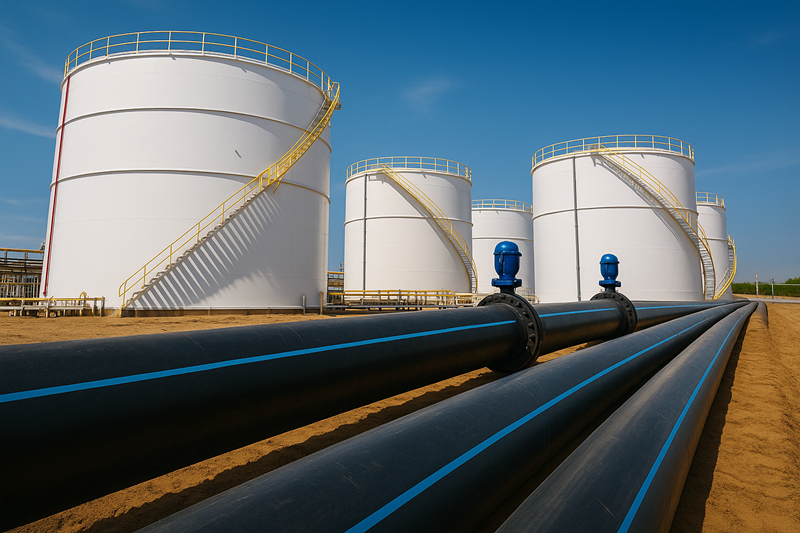
INTRODUCTION: THE HIDDEN COMPLEXITY OF DESALINATION PIPELINES
When engineers plan a SWRO facility, the headline numbers are always about capacity — cubic meters per day, recovery rate, energy consumption per liter. But behind every successful plant lies a less glamorous truth: the entire operation depends on a continuous, corrosion-free, pressure-tight pipeline network that starts at the seabed intake screen and ends at the subsea brine diffuser.
At Smart Joint, we have dedicated our engineering focus to this exact challenge — the design, fabrication, and supply of large-diameter, non-standard HDPE fittings and prefabricated spools that form the critical "joints" of SWRO intake and outfall systems worldwide.
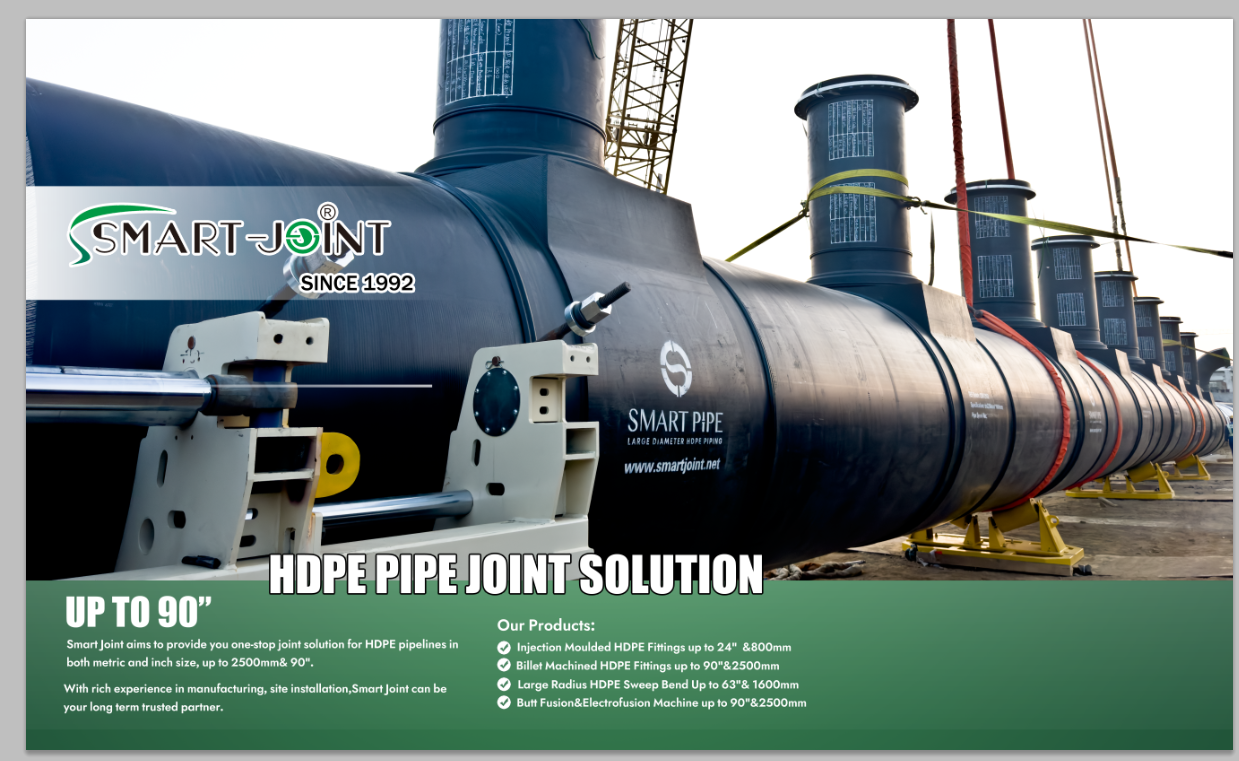
UNDERSTANDING THE SWRO PIPELINE ARCHITECTURE
A typical SWRO plant requires two major HDPE pipeline systems:
1. THE SEAWATER INTAKE SYSTEM (Raw Water → Pretreatment)
2. THE BRINE OUTFALL SYSTEM (Concentrate Discharge → Sea)
Both systems operate in environments that are brutally unforgiving to conventional materials — continuous salt water exposure, cyclic wave loading, potential storm-surge conditions, and complex interface requirements with concrete, GRP/FRP, and stainless steel structures.
This is precisely why high-density polyethylene (HDPE) PE100 — and increasingly PE100-RC for crack-resistant applications — has emerged as the material of choice for SWRO pipelines globally.
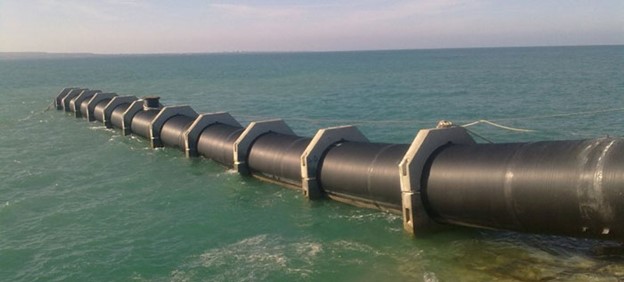
WHY HDPE PE100 DOMINATES SWRO APPLICATIONS
The technical case for HDPE in seawater desalination is overwhelming:
• ZERO CORROSION: Unlike carbon steel (even with FBE or 3LPE coating), HDPE suffers no electrochemical corrosion in saline environments. No cathodic protection. No coating degradation. No rust.
• SUPERIOR FATIGUE RESISTANCE: Under cyclic wave and tidal loading, HDPE's viscoelastic properties absorb stress far better than rigid materials. Critical for subsea and intertidal installations.
• EXCEPTIONAL FLEXIBILITY: HDPE's ability to bend (minimum bending radius ~25×OD for SDR 17) makes it ideal for horizontal directional drilling (HDD) installations — allowing intake pipelines to be drilled from onshore locations to deep-sea intake points without open trenching.
• LEAK-FREE JOINTS: Butt fusion welding creates homogeneous, monolithic joints with strength equal to the pipe wall itself — eliminating the leak paths inherent in mechanical joints.
• 50-YEAR DESIGN LIFE: Compliant with ISO 4427 and EN 12201, PE100 HDPE systems are engineered for half-century service with minimal maintenance.
• LOWER LIFECYCLE COST (LCC): When total installed cost + maintenance + replacement is calculated, HDPE consistently outperforms coated steel, ductile iron, and lined carbon steel in SWRO service.
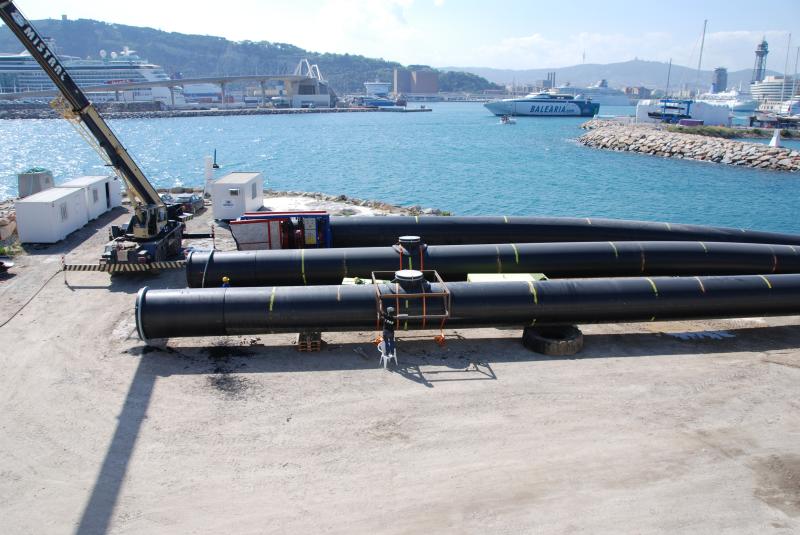
THE BOTTLENECK: BEYOND STANDARD FITTINGS
Here is the industry's dirty secret: injection-moulded HDPE fittings are commercially available only up to approximately DN 630. Beyond that diameter — which covers virtually every modern SWRO intake and outfall line — every single elbow, tee, reducer, manhole transition, flange adapter, and diffuser manifold must be CUSTOM-FABRICATED and BUTT-FUSED under controlled conditions.
This is where Smart Joint operates.
We don't compete in commodity straight pipe. We own the oversized, the irregular, and the mission-critical. Our workshop is engineered for the exact opposite of "off-the-shelf."